This is the guide I wish someone had handed me before my first day. It starts with a question most people skip, what is money, and then climbs one step at a time until we are reading block headers and doing mining math. Every section carries a label so you know where you are:
Anyone can read it. No background needed.
How the pieces work together.
The engineering and the math.
Read straight through, jump around with the road map, or use the level buttons to show only the parts you want.
Simple Feel more than comfortable to only stay in the Simple section.
Simple: the ideas
No math, no jargon. If you only read this part, you will understand Bitcoin better than most people who own some.
What money does Simple
Before we can understand Bitcoin, we have to understand money itself. Money is anything people agree to use for three jobs:
Money is not a fixed thing. It has changed shape many times over thousands of years, and each change looked strange to the people living through it.
From cows to code Simple
Money has been upgraded four big times. Tap or click any stop on the timeline to open the story behind it.
🐄 Barter: a trade for a trade
Before money, people swapped goods directly: two cows for ten chickens, three sheep for a bag of wheat. It had four big problems:
- Double coincidence of wants: both people had to want exactly what the other had.
- No common measure: nobody agreed how many chickens a cow was worth.
- Spoilage: grain rots and animals age or die.
- Not portable: try carrying ten sheep to market.
Barter is still around in small ways, like businesses trading services, but every society that grew past the village level invented money to replace it. More on barter
🪙 Coins: about 600 BC
The kingdom of Lydia, in western Turkey, stamped the first standard coins from electrum, a natural mix of gold and silver. A stamped coin promised a known weight, so traders no longer had to weigh and test metal on every deal. Coins spread through Greece, Persia and Rome.
Coins also introduced a lesson about who controls money. Roman emperors steadily reduced the silver in the denarius to pay for wars, and prices rose as each coin held less metal. People said they could not eat gold or milk silver, yet within a few generations coins were normal. History of money
💴 Paper: Tang and Song dynasty China
Merchants in Tang dynasty China used "flying cash," paper receipts for coins stored elsewhere. Around 1024 the Song government issued the jiaozi, among the first government paper money. Paper was light, could stand for any amount and was easy to move.
It also showed the risk of printing too much: later dynasties printed so many notes that prices soared. In the West, paper notes were long tied to gold. The United States ended the last link between the dollar and gold in 1971. Since then, dollars are backed by trust in the government that issues them. Jiaozi · The 1971 Nixon shock
💳 Digital: the 20th century
The Diners Club card arrived in 1950 and bank cards followed. Banks linked up through networks like SWIFT in 1973, then came online banking in the 1990s and phone payments in the 2010s. Money became numbers in databases.
Today, by most estimates, the large majority of money exists only as entries in bank ledgers, and cash is a small slice. That works well, and it means the bank, not you, keeps the record of what you own. The next section looks at what that means. History of the credit card
₿ Bitcoin: 2009
Satoshi Nakamoto published the Bitcoin white paper on October 31, 2008, and mined the first block on January 3, 2009. That first block carries a newspaper headline as a time stamp: "Chancellor on brink of second bailout for banks."
In May 2010 a programmer paid 10,000 BTC for two pizzas, the first well known purchase. Bitcoin went on to pass $1 in 2011, $1,000 in 2013, and $100,000 in December 2024. In January 2024 the SEC approved US spot bitcoin ETFs. Like every money before it, it met resistance before it went mainstream. The white paper · History of bitcoin
Look at the quotes. When coins arrived, people said they could not eat gold or milk silver. When paper arrived, a scrap of paper felt worthless next to the weight of a coin. When money became numbers on a screen, people wanted bills they could hold. That is the backdrop for Bitcoin.
Enter Bitcoin Simple
On October 31, 2008, someone using the name Satoshi Nakamoto published a nine page paper called Bitcoin: A Peer to Peer Electronic Cash System. On January 3, 2009, the network produced its first block. Nobody knows for certain who Satoshi is, and the network has kept running without them since 2010.
Bitcoin is fully digital money that moves between people without a bank, card company or government in the middle. Three traits make it different:
And yes, it met the same resistance as every money before it: "it's not real money," "you can't touch it," "it's just internet magic." The same things were said about coins, paper and cards.
How money works right now Simple
When your paycheck lands, no truck delivers bills to your house. Your bank adds a number to a row in its ledger, a private database with your name on it. When you pay rent, the bank subtracts from that row and tells another bank to add to someone else's. Your "money in the bank" is really the bank's promise, written in the bank's records.
For most people, most of the time, that works well. Deposits are insured up to limits, and payments settle smoothly. But it means you do not control your own ledger. Someone else holds the record and can decide, for their own reasons or under orders, when and how much of your money you can reach. That has happened many times:
Banks closed for nearly two weeks. Under the bailout deal, Bank of Cyprus depositors lost 47.5% of their savings above the 100,000 euro insured limit, converted into bank shares. AP report · Background
Banks shut for about three weeks, cash withdrawals were capped at 60 euros a day, and money transfers abroad were restricted. The last controls were lifted in September 2019. VOA · Background
After banks reopened from the October 2019 protests, they limited dollar withdrawals without any capital control law, to as little as $200 a week at some banks, and often paid out in local currency at poor rates. Al Jazeera · Background
The government announced that 500 and 1,000 rupee notes, about 86% of the cash in circulation by value, would stop being legal tender at midnight. For weeks, exchanges and withdrawals were capped. Background
Under the Emergencies Act during the convoy protests, banks froze about 200 accounts holding roughly C$7.8 million. Most were unfrozen within days after the order ended. American Banker (Bloomberg) · Background
Customers pulled about $42 billion in one day and regulators closed the bank on a Friday. Roughly 89% of deposits were above the insured limit. Access returned on Monday only after the Treasury, Fed and FDIC stepped in. Federal Reserve statement · Background
More than 100,000 customers of apps built on the fintech Synapse were locked out of their money. A bankruptcy trustee found partner banks held about $85 million less than customers were owed, because the ledgers did not match. NBC News · US Senate Banking Committee
A 2023 New York Times investigation found hundreds of cases where banks closed customer accounts with little explanation, often tied to rising suspicious activity reports, leaving people cut off for days or weeks. Fortune summary
The same is true of crypto held by a company. In 2022 Celsius froze withdrawals for its roughly 1.7 million customers, and FTX stopped withdrawals days before filing for bankruptcy. FTX customers were later projected to recover more than their claims, but they waited years. If an exchange holds your keys, it holds your ledger too. Celsius · FTX
That is the core idea behind Bitcoin: a ledger nobody owns. Bitcoin held with your own keys sits on a public record that no single bank, company or government controls. Nobody can freeze it, and nobody can rescue it if you lose the keys. That tradeoff runs through the rest of this guide.
What a bitcoin costs Simple
There is no official price of bitcoin. The price is whatever buyers and sellers agree to on exchanges around the world, minute by minute, every day of the year. Here is the live price right now:
Live data from CoinGecko, with Coinbase as a backup. It refreshes every 60 seconds. For information only, not a quote or advice.
Bitcoin's price has been famously volatile. A few milestones show the scale:
| When | What happened |
|---|---|
| May 2010 | 10,000 BTC buys two pizzas, about $41 worth at the time |
| February 2011 | 1 BTC reaches $1 |
| November 2013 | passes $1,000 |
| December 2017 | nears $20,000 |
| November 2021 | reaches about $69,000 |
| December 2024 | passes $100,000 for the first time |
Big drops happened along the way too, several of more than 70 percent from a peak. The price moves with demand, news, interest rates and the halving cycle, while the supply schedule stays fixed. See the history of bitcoin for the full story.
The Bitcoin team Simple
Three kinds of participants keep Bitcoin running. Think of them as a team where nobody is the boss.
Nodes: the record keepers
Computers that each keep a full copy of every Bitcoin transaction since 2009. They check that every new transaction follows the rules and reject anything that does not. Think of a town where every citizen holds a copy of the town ledger: if one person lies, everyone else notices. Thousands of nodes run around the world.
ASICs: the workers
Specialized computers that gather transactions into blocks and add them to the chain. Their work is what makes the record hard to change. In return they receive newly created bitcoin plus fees.
Wallets: your access
Software or a small device that holds your keys. A wallet does not hold coins the way a leather wallet holds cash. It holds the keys that let you move coins recorded on the blockchain.
Jargon in plain English Simple
Bitcoin people borrowed words from gold rushes and lotteries. Here is what they actually mean:
Wallets and keys Simple
Every wallet is built on a pair of keys. The easiest way to picture them is a mailbox.
- Public key or address: like your mailing address. You give it to anyone who wants to send you bitcoin.
- Private key: like the only key to the box. Whoever has it controls the coins, so it stays private.
- Software wallets are apps on a phone or computer. Hardware wallets are small devices that keep the keys offline.
- Seed phrase: most wallets show 12 or 24 ordinary words when you set them up. Those words can rebuild every key in the wallet, so anyone who sees them can take the coins.
Small change: satoshis Simple
You do not have to buy a whole bitcoin. Each bitcoin divides into 100,000,000 satoshis, or "sats," named after the creator. A dollar can buy sats the same way it can buy a fraction of a share of stock. The live box above shows how many sats a dollar buys right now.
| Amount | In sats |
|---|---|
| 1 BTC | 100,000,000 sats |
| 0.01 BTC | 1,000,000 sats |
| 0.0001 BTC | 10,000 sats |
| 0.00000001 BTC | 1 sat, the smallest unit |
Bitcoin and the crypto family Simple
"Crypto" covers thousands of digital assets. They fall into a few families:
Bitcoin is the oldest and the largest by market value, and it does one thing: move and store bitcoin. Most other networks add programmable features on top. Part 3 covers how they differ.
Everything else, simply Simple
Parts 2 and 3 go deep. Before we get there, here is every big idea in a few plain sentences. Tap a topic to open it; opening one closes the last. Each has a link to the deeper version.
🖥️ASICs: the machines that make bitcoin
An ASIC is a computer built for exactly one job: running Bitcoin's puzzle as fast as possible. It cannot browse the web or run apps. Plug it into power and the internet, point it at a pool, and it starts guessing answers trillions of times per second.
When an ASIC, or the pool it belongs to, finds a winning answer, it gets to add the next page to the ledger and is paid in brand new bitcoin plus the fees people attached to their payments. That payment is the only way new bitcoin is created. No bank or government prints it.
Go deeper: Inside an ASIC · Mining economics
⛏️Mining: what "solving the puzzle" means
Picture a lottery where tickets are free to check but expensive to print. Every guess an ASIC makes is a ticket. Printing tickets costs electricity. Checking whether a ticket wins takes everyone else a split second.
That is the trick that keeps Bitcoin honest: adding a page to the ledger costs real work, but anyone can confirm the work was done. Cheating would mean redoing that work faster than the rest of the world combined.
Go deeper: Proof of work under the hood
🎚️Difficulty: Bitcoin's thermostat
Bitcoin aims for one new block about every 10 minutes, no matter how many machines are mining. When more machines join, blocks start coming faster, so about every two weeks the network makes the puzzle harder. When machines shut off, it makes the puzzle easier.
Think of a thermostat that keeps the room at 10 minutes. That is why adding machines to the network does not print bitcoin faster. It just raises the bar for everyone.
Go deeper: The difficulty adjustment
✂️The halving: a pay cut every four years
Miners started out earning 50 new bitcoin per block. About every four years that payment is cut in half: 25, then 12.5, then 6.25, and since April 2024, 3.125. The next cut is expected around 2028.
Halvings are why there will only ever be just under 21 million bitcoin, and why the last tiny fractions arrive around the year 2140. Each halving also cuts miners' income from new coins in half overnight.
Go deeper: Supply and the halving
⛓️The blockchain: a public ledger nobody can quietly edit
The blockchain is a long list of pages called blocks, starting in January 2009. Each page lists payments and carries a fingerprint of the page before it, so the pages are chained together.
Change one old payment and its page's fingerprint changes, which breaks every page after it. Thousands of computers hold copies, so a tampered copy stands out immediately.
Go deeper: Blocks and the chain · Merkle trees
🔑Wallets and keys, in one minute
Your bitcoin is not stored in your wallet. It lives on the blockchain. Your wallet holds the private key that proves you can move it, like the only key to a mailbox anyone can drop mail into.
Write your 12 or 24 word seed phrase on paper and keep it private. Anyone with those words controls the coins, and anyone without them cannot help you recover them.
Go deeper: Wallets and keys · Coins, keys and signatures
📤Sending bitcoin and paying fees
To pay someone, your wallet signs a message saying "move these coins to this address" and broadcasts it. Payments wait in a public waiting room until a miner puts them in a block.
Blocks have limited room, so you attach a fee to get in line. A higher fee usually means faster confirmation. Small, everyday payments can also travel on the Lightning Network, which settles in seconds for tiny fees.
Go deeper: How a payment travels · Fees and the waiting room
👥Pools: why miners team up
One machine alone might find a block once in a century. So miners join pools, combine their guessing power and split each payment by how much work each contributed. The result is a small, steady income instead of a lottery ticket.
Go deeper: Solo mining and pools
#️⃣Hash rate: horsepower for mining
Hash rate is how many guesses per second a machine, a site or the whole network makes. One modern machine makes hundreds of trillions per second. The whole network makes about a billion trillion. More hash rate across the network means a stronger, more expensive to attack ledger.
Go deeper: Hash rate and its units
🖧Nodes: everyone can check everything
A node is any computer running Bitcoin software that keeps a full copy of the ledger and checks every rule. You can run one at home on a basic computer. Nodes reject bad blocks even if a miner produced them, which is why miners cannot change the rules by themselves.
Go deeper: The Bitcoin team · Consensus and attacks
🛡️Security: how your bitcoin is protected
Bitcoin is protected in layers:
- Math: only the matching private key can sign for your coins. Guessing someone's key is like guessing one specific grain of sand among all the beaches on many Earths.
- Copies: thousands of nodes hold the ledger and reject rule breaking changes.
- Work: rewriting history would mean outspending the whole mining network on machines and power.
- You: the weakest link is usually the human. Scams, phishing and lost seed phrases cause far more losses than any attack on Bitcoin itself.
Go deeper: Consensus and attacks, the math · Scams
🔌Power: why mining uses so much, and how it helps the grid
Every guess costs a little electricity, and the network makes a staggering number of guesses, so mining uses as much power as some countries. That power is what makes the ledger expensive to attack.
Mining has an unusual feature: machines can switch off in seconds without harming anything. When a grid is strained on a hot afternoon or a frozen night, miners can shut down and hand the power back to homes and hospitals, and some grid programs pay them to do it.
Go deeper: Power and the grid
🏗️Hosting facilities: where the machines live
Most ASICs run in hosting facilities: fenced sites with their own substation, rows of containers or metal buildings full of machines, big fans to move the heat out and technicians watching every machine. Owners usually pay the host for power and care.
Go deeper: Inside a hosting facility
💲Stablecoins: digital dollars
A stablecoin is a token built to stay at $1. It moves like crypto, fast and worldwide, but holds steady like a dollar because the issuer keeps reserves. USDT and USDC are the biggest.
Go deeper: Stablecoins and networks
⚡Lightning: Bitcoin's express lane
Lightning lets two people open a tab backed by real bitcoin and pay each other instantly, as many times as they like, then settle the final total on the main chain. Payments can hop across many tabs, so you can pay someone you have no tab with.
Go deeper: The Lightning Network
⚖️Proof of stake: the other way to run a chain
Bitcoin uses machines and electricity to pick who adds the next block. Many other chains, like Ethereum since 2022, instead pick from people who lock up coins as a deposit. Cheat and you lose the deposit. It uses far less energy, and people debate which approach is more secure.
Go deeper: Proof of work and proof of stake
⚛️Quantum computers: the future threat, simply
A large enough quantum computer could, in theory, work out a private key from a public key. Today's quantum machines are thousands of times too small to do that. Meanwhile, quantum resistant signatures are already standardized and Bitcoin developers are drafting upgrades to use them.
Go deeper: Quantum computers and Bitcoin
🏛️ETFs, DeFi, NFTs and CBDCs
- Bitcoin ETFs: funds you buy in a normal brokerage account that hold bitcoin for you.
- DeFi: lending and trading run by code instead of a company.
- NFTs: one of a kind tokens, used for art, tickets and collectibles.
- CBDCs: digital money issued and controlled by a central bank, the opposite of Bitcoin's design.
Go deeper: DeFi, tokens, ETFs and CBDCs
📋Taxes and rules
In the United States the IRS treats bitcoin as property, so selling, trading or spending it can trigger taxes, and mined coins count as income. Rules vary by country and change often, so a tax professional is the right person for specifics.
Go deeper: Rules and taxes
Medium: how the pieces fit
Now we follow a payment through the system and open up the machines that secure it.
How a payment travels Medium
Say Alice sends Bob 0.01 BTC. Here is the trip that payment takes:
Notice who is missing: no bank approves the payment. The rules are checked by thousands of independent nodes, and the ordering is settled by miners competing to add the next block.
Blocks and the chain Medium
A block is a page in the ledger. It holds a batch of transactions plus a short header. The header includes a fingerprint, called a hash, of the block before it. That is what chains the pages together.
This is why the ledger is called tamper evident. Every node can recompute the hashes in seconds and spot an edit immediately.
Inside an ASIC Medium
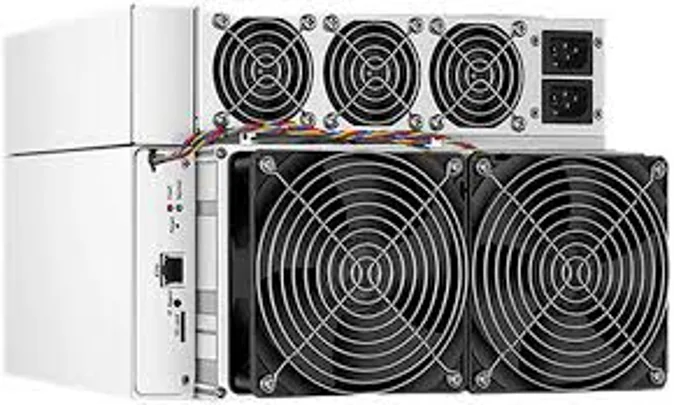
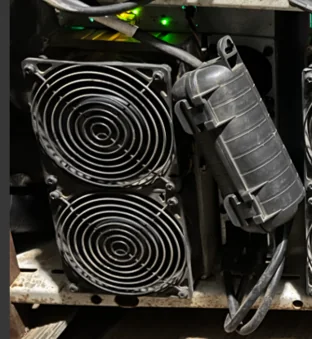
ASIC stands for Application Specific Integrated Circuit: a computer chip built to do exactly one task. A Bitcoin ASIC runs one calculation, SHA‑256, over and over at enormous speed. Here is a common workhorse model, the Bitmain Antminer S19 XP:
| Spec (Antminer S19 XP) | Value | In plain terms |
|---|---|---|
| Hash rate | about 141 TH/s | 141 trillion guesses every second |
| Power draw | 3,010 watts | roughly 30 bright 100 watt bulbs, around the clock |
| Efficiency | about 21.4 J/TH | energy used per trillion guesses; lower is more efficient |
| Weight and size | about 47 lb, 17 × 8 × 11 inches | a heavy shoebox |
| Noise | about 75 dB | similar to a vacuum cleaner |
| Chips | 5 nm process | the same class of chip process used in recent phones |
Hash rate and its units Medium
Every guess an ASIC makes is called a hash. Hash rate is guesses per second. The numbers get large quickly, so they use the same prefixes as computer storage:
| Unit | Name | Equals |
|---|---|---|
| TH/s | terahash | 1 trillion hashes per second |
| PH/s | petahash | 1,000 TH/s |
| EH/s | exahash | 1,000 PH/s |
| ZH/s | zettahash | 1,000 EH/s |
For perspective: if all 8 billion people on Earth each made one guess per second, together they would still be about 17,000 times slower than a single S19 XP.
From laptops to ASICs Medium
In 2009 Satoshi mined the first blocks on an ordinary computer, and anyone with a laptop could earn coins. Gamers then found graphics cards were far faster. From 2013 on, purpose built ASICs took over, and mining moved from bedrooms to industrial buildings.
Solo mining and pools Medium
A new block arrives about every 10 minutes, and only one miner wins each one. One S19 XP has about 141 TH/s against a network near 1,000,000,000 TH/s. On average, a single machine mining alone would find a block roughly once every 135 years. It could happen tomorrow, or not once in the machine's working life.
That is why nearly all mining runs through pools. Machines send the pool small proofs of work called shares. When anyone in the pool finds a block, the payment is split by each member's shares. Pools pay in different ways. Some pay for every share whether or not a block is found, and others pay only from the blocks the pool actually finds. A pool's choice of method and fee changes what a machine earns on a given day.
Supply and the halving Medium
New bitcoin enters circulation only as payment to miners. The payment per block started at 50 BTC and is cut in half every 210,000 blocks, about every four years. That event is the halving. It is why the supply approaches 21 million but stops short, with the last fractions due around the year 2140.
Every halving, past and future
| # | Block | Date | Reward per block after |
|---|---|---|---|
| 1 | 210,000 | November 28, 2012 | 25 BTC |
| 2 | 420,000 | July 9, 2016 | 12.5 BTC |
| 3 | 630,000 | May 11, 2020 | 6.25 BTC |
| 4 | 840,000 | April 20, 2024 | 3.125 BTC |
| 5 | 1,050,000 | about April 2028 | 1.5625 BTC |
| 6 | 1,260,000 | April 2032 | 0.78125 BTC |
| 7 | 1,470,000 | 2036 | 0.390625 BTC |
| 8 | 1,680,000 | 2040 | 0.1953125 BTC |
| 9 | 1,890,000 | 2044 | 0.09765625 BTC |
| 10 | 2,100,000 | 2048 | 0.04882812 BTC |
| 11 | 2,310,000 | 2052 | 0.02441406 BTC |
| 12 | 2,520,000 | 2056 | 0.01220703 BTC |
| 13 | 2,730,000 | 2060 | 0.00610351 BTC |
| 14 | 2,940,000 | 2064 | 0.00305175 BTC |
| 15 | 3,150,000 | 2068 | 0.00152587 BTC |
| 16 | 3,360,000 | 2072 | 0.00076293 BTC |
| 17 | 3,570,000 | 2076 | 0.00038146 BTC |
| 18 | 3,780,000 | 2080 | 0.00019073 BTC |
| 19 | 3,990,000 | 2084 | 0.00009536 BTC |
| 20 | 4,200,000 | 2088 | 0.00004768 BTC |
| 21 | 4,410,000 | 2092 | 0.00002384 BTC |
| 22 | 4,620,000 | 2096 | 0.00001192 BTC |
| 23 | 4,830,000 | 2100 | 0.00000596 BTC |
| 24 | 5,040,000 | 2104 | 0.00000298 BTC |
| 25 | 5,250,000 | 2108 | 0.00000149 BTC |
| 26 | 5,460,000 | 2112 | 74 sats (0.00000074 BTC) |
| 27 | 5,670,000 | 2116 | 37 sats (0.00000037 BTC) |
| 28 | 5,880,000 | 2120 | 18 sats (0.00000018 BTC) |
| 29 | 6,090,000 | 2124 | 9 sats (0.00000009 BTC) |
| 30 | 6,300,000 | 2128 | 4 sats (0.00000004 BTC) |
| 31 | 6,510,000 | 2132 | 2 sats (0.00000002 BTC) |
| 32 | 6,720,000 | 2136 | 1 sat (0.00000001 BTC) |
| 33 | 6,930,000 | 2140 | 0 (subsidy ends; miners earn fees only) |
Past dates are actual. Future dates are estimates at the 10 minute target pace from block 972,522 (October 21, 2026); recent blocks have averaged about 9.4 minutes, so the real dates tend to come a little earlier. The reward is halved by shifting the satoshi amount, so it reaches exactly zero at the 33rd halving, block 6,930,000, around 2140. Total issued then: 20,999,999.9769 BTC.
By late 2026 roughly 20 million of the 21 million bitcoin exist. Today the network issues about 450 new BTC per day: 144 blocks times 3.125 BTC. A halving cuts that in half overnight, which is why miners plan around it. A case we covered, a dispute that turned on halving timing, shows how much rides on that date.
Fees and the waiting room Medium
Each block has limited space, about 4 million "weight units," which usually fits a few thousand transactions. When more people want in than will fit, they bid with fees. Fees are quoted in sats per virtual byte (sat/vB), because bigger transactions use more space. Miners usually fill blocks with the highest paying transactions first.
The mempool is the waiting room. On a quiet day a low fee clears in the next block or two. During a rush, low fee payments can wait for hours or days. Miners collect these fees on top of the block reward, and as halvings shrink the reward, fees become a larger share of what keeps miners running.
Power and the grid Medium
Every hash costs a little electricity, and the network makes about a billion trillion hashes per second, so Bitcoin mining uses a lot of power. A 2025 University of Cambridge study estimated about 138 TWh per year, roughly 0.5% of the world's electricity. The same survey found 52.4% of mining power came from sustainable sources (42.6% renewables and 9.8% nuclear), up from 37.6% in 2022, while coal fell from 36.6% to 8.9% and natural gas rose to 38.2%. In the United States, the Energy Information Administration estimated in 2024 that crypto mining used 0.6% to 2.3% of the country's electricity.
The unusual part: miners can switch off in seconds
Most big power users cannot stop on short notice. A hospital, a steel mill or a data center serving websites has to keep running. An ASIC can power down in seconds and restart later, losing only the bitcoin it would have earned in between. That makes a mining site one of the most flexible loads a grid can have: it soaks up spare power when there is plenty and hands it back when there is not.
When it has actually happened
- Winter Storm Uri, February 2021, Texas. As the grid neared collapse, mining sites shut down. ERCOT paid one Rockdale mine an average of about $175,000 an hour for the power it gave back. The Independent
- July 2022 heat wave. ERCOT set a record peak of 78,206 MW. The Texas Blockchain Council said miners returned more than 1,000 MW for stretches of 10 hours or more, and Riot Platforms alone curtailed 11,717 MWh that month. Texas Tribune · Decrypt
- Winter Storm Elliott, December 2022. According to an ERCOT task force presentation, large flexible loads cut their use from 1,530 MW to 130 MW, a 96% response, and all 20 tracked sites curtailed. The same month ERCOT created a voluntary curtailment program for large flexible loads "such as bitcoin mining facilities." ERCOT task force deck · ERCOT
- August 2023 heat. Riot reported $31.7 million in power and demand response credits for one month, curtailing more than 95% of its load at peak times. Riot Platforms
- January 2024 freeze. Network hash rate fell about 34% in four days as Texas miners powered down. Cointelegraph
- January 2026 winter storm. The Foundry USA pool's hash rate dropped from about 260 to 124 EH/s in two days as US miners eased load on stressed grids. Decrypt
Why grid planners care
ERCOT lets qualifying flexible loads register as Controllable Load Resources, dispatched in real time like a power plant, and counts a reduction in load the same as added generation. ERCOT explainer. A 2025 Duke University study found US grids could add about 76 GW of new demand if those loads agreed to curtail just 0.25% of the year. Utility Dive. Researchers at Cornell estimated mining revenue could help fund new solar and wind projects by buying their power before transmission is built. Cornell. Some companies also run miners on natural gas that oil fields would otherwise flare. Crusoe
The other side of the debate
Critics raise real points. An ERCOT staff analysis found that loads curtailing on their own, outside formal programs, make demand harder to forecast. Advocacy groups cite estimates that mining raises Texas power costs. Earthjustice. Neighbors of some sites have sued over noise, a case we covered in the Granbury noise lawsuits, and a 2025 Harvard study linked large mines to higher fine particle pollution near the power plants that supply them. Harvard. For how curtailment works in power contracts, see curtailment explained.
Inside a hosting facility Medium
Most of the world's ASICs do not sit in anyone's garage. They run in hosting facilities: sites built to deliver a lot of electricity, move a lot of air and keep thousands of machines online. Owners of the machines often pay a host, usually per kilowatt hour, to provide the power, space, cooling, internet, security and day to day care. (For how those deals are written, see reading a hosting agreement.)
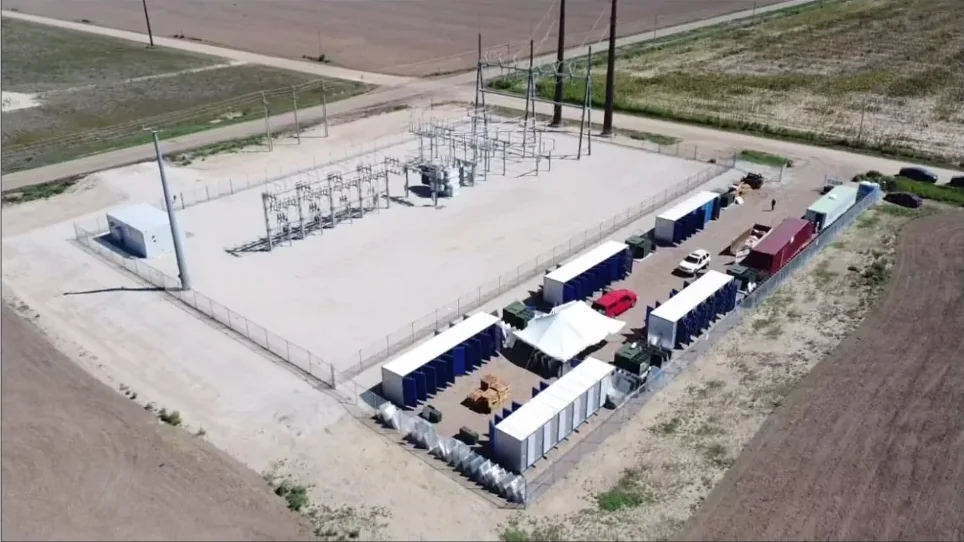
The pieces of a site
- Substation and transformers. Grid power arrives at high voltage. A substation and pad mounted transformers step it down to the voltage the machines' power supplies use.
- Containers or buildings. Many sites use shipping container style "mobile data centers." They are built in a factory, set on simple foundations and can be moved if the power deal changes. Others use large metal buildings.
- Racks, breakers and network. Inside, machines sit on shelves wired to breaker panels, and every machine has a network cable back to switches that connect the site to its mining pool.
- Monitoring. Software watches every machine's hash rate, temperature, fan speed and errors around the clock, so technicians know which unit needs attention.
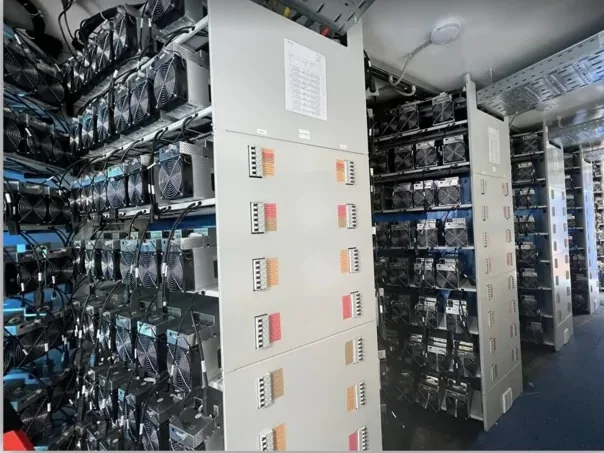
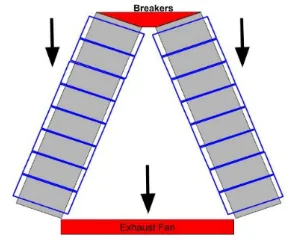
Air in, air out
Nearly every watt a machine uses turns into heat, so an air cooled site is really a giant air handler. Outside air comes in through filters, passes over the machines and leaves as hot exhaust.
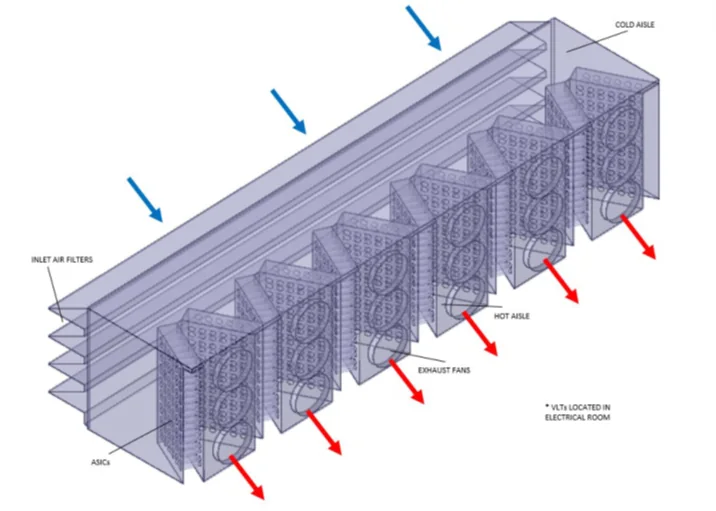
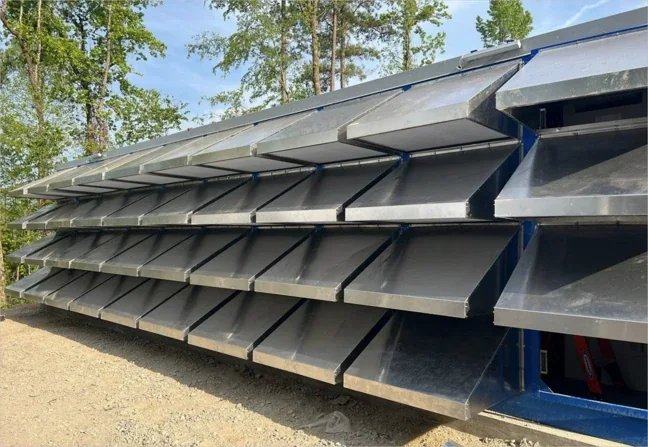
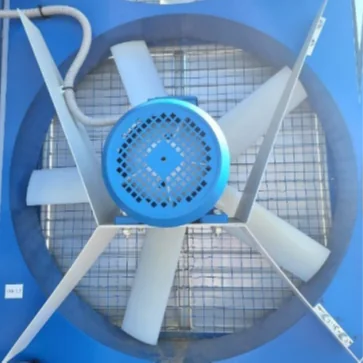
For more on how air moves through these sites, see hot air and cold air, and for the electrical side, power basics for ASIC sites. Disputes over hosted machines are the subject of my ASIC hosting expert witness page.
Stablecoins and networks Medium
Not all crypto swings in price. Stablecoins are tokens designed to stay at one dollar each. They pair the speed and reach of crypto with the steady value of a dollar, and they live on a blockchain instead of in a bank.
| USDT (Tether) | USDC (USD Coin) | |
|---|---|---|
| Issuer | Tether | Circle |
| Backing, as described by the issuer | reserves including US Treasury bills and cash equivalents | cash and short term US Treasuries, with published reserve reports |
| Common network | Tron (TRC‑20), also Ethereum | Ethereum (ERC‑20), plus others |
The same token can live on several networks. ERC‑20 means a token on Ethereum, the original smart contract chain, where fees are usually higher. TRC‑20 means a token on Tron, built for low fees and fast transfers. Sending a token on the wrong network is a common way to lose it, which is why exchanges ask you to pick the network on every withdrawal. In the United States, the GENIUS Act, signed in July 2025, set the first federal framework for payment stablecoins.
Exchanges, self custody and scams Medium
There are two basic ways to hold crypto:
On an exchange
Easy to buy and sell. The exchange holds the keys and you hold a claim on it, much like a bank account. The tradeoff is trust: if the exchange fails or freezes withdrawals, as several did in 2022, customers wait on that company.
Self custody
You hold your own keys in a software or hardware wallet. No company can freeze them. The tradeoff is responsibility: lose the seed phrase and nobody can recover the coins.
Because crypto payments are fast and hard to reverse, they attract fraud. The FBI's Internet Crime Complaint Center and the FTC have published warnings about patterns like these:
- Guaranteed returns. Investment or "cloud mining" offers promising fixed daily profits.
- Romance and "pig butchering" schemes. A new online friend steers you to a trading site that shows fake gains.
- Fake support. Someone posing as an exchange or wallet company asks for your seed phrase or remote access.
- Giveaways. "Send 1 BTC, get 2 back," often with a deepfaked celebrity video.
The common thread: real wallet companies do not ask for your seed phrase, and real investments do not promise fixed profits.
Complex: the engineering and the math
Hashing, difficulty, mining economics, the data structures inside a block, and how other networks do things differently.
Proof of work under the hood Complex
The "math puzzle" miners solve is simple to state and very hard to shortcut. A miner takes the 80 byte block header and runs it through SHA‑256 twice. The output is a 256 bit number. If that number is below a target set by the network, the block is valid. If not, the miner changes a field called the nonce and tries again.
Two properties make this work. A hash is easy to check: any node verifies a winning block with a single calculation. It is impossible to predict: changing one bit of input scrambles the whole output, so the only strategy is brute force. That asymmetry is the heart of proof of work. Finding a block is expensive and verifying it is nearly free.
The 32 bit nonce gives only about 4.3 billion tries, which a modern ASIC burns through in a fraction of a millisecond. Miners also vary an "extra nonce" inside the first transaction of the block, which changes the Merkle root and opens a fresh set of tries.
Going deeper: the header, the target and the hash
| Header field | Bytes | What it holds |
|---|---|---|
| version | 4 | rule version; 16 of its bits are also rolled as extra nonce space (BIP 320) |
| previous block hash | 32 | double SHA‑256 of the prior header, the link in the chain |
| Merkle root | 32 | one hash committing to every transaction in the block |
| time | 4 | Unix timestamp in seconds |
| bits | 4 | the target, packed into a compact floating point form |
| nonce | 4 | the counter miners change on every try |
From bits to target. The compact "bits" field holds an exponent byte and a 3 byte coefficient:
The genesis block used bits 0x1d00ffff, so its target was 0xFFFF × 2208. That is the "difficulty 1" target, and difficulty is defined against it:
Rearranged for a 600 second block: difficulty ≈ network hash rate × 600 ÷ 232. At about 1 ZH/s (1021 hashes per second) that gives a difficulty near 1.4 × 10¹⁴, about 140 trillion, which is the scale of the number published on block explorers.
Inside SHA‑256. SHA‑256 works on 512 bit chunks. Each chunk is expanded into a 64 word message schedule and pushed through 64 rounds that mix eight 32 bit working words with rotations, additions and the Ch, Maj and Σ functions. The 80 byte header fills one full chunk plus part of a second. Because the first 64 bytes do not change while a miner rolls the nonce, ASICs compute that first chunk once (the "midstate") and then only run the second chunk and the outer hash on each try. Roughly two compression passes per nonce instead of three.
AsicBoost. In 2016 Timo Hanke described a way to reuse part of the message schedule across tries by finding headers that share the last 4 bytes of the Merkle root. The open version of the trick rolls bits in the version field, which BIP 320 set aside for that purpose, and it is now standard in mining firmware and pool protocols. Miners also roll an extranonce inside the coinbase transaction and, within limits, the timestamp, which gives effectively unlimited search space.
The difficulty adjustment Complex
If more machines join, blocks would come faster than every 10 minutes. Bitcoin corrects for that on its own. Every 2,016 blocks, about two weeks, each node compares how long those blocks actually took with the 20,160 minute goal and moves the target. A single adjustment can change difficulty by up to a factor of four in either direction.
This is why a miner's output depends on everyone else. Add the same machine to a network that grew 10 percent and it earns about 10 percent less bitcoin, with no change in the machine itself.
Going deeper: the retarget formula and block timing
1,209,600 seconds is two weeks: 2,016 blocks times 600 seconds. The measured time is clamped between one quarter and four times that span, which limits any single change to a factor of four. A higher target means an easier puzzle. A quirk of the original code measures 2,015 intervals instead of 2,016, one of several edge cases, along with the "time warp" timestamp trick, that the proposed Great Consensus Cleanup soft fork would tidy up.
Timestamp rules. A block's time has to be later than the median of the previous 11 blocks, and no more than two hours ahead of a node's network adjusted clock. Miners have some freedom inside that window, which is why block times are not strictly increasing.
Blocks arrive randomly. Finding a block is a memoryless process, so block intervals follow an exponential distribution with a 10 minute mean. The chance of waiting longer than t minutes is e−t/10: about 37% of blocks take longer than 10 minutes, about 5% longer than 30, and about 0.25% longer than an hour. Long gaps are normal, not a sign that something broke.
Mining economics, the math Complex
A machine's share of new bitcoin is its share of the network's hash rate. Everything else follows from three formulas:
Here is a worked example using round numbers: network hash rate of 1,000 EH/s, a bitcoin price of $100,000 and power at $0.05 per kWh. These are illustrations, not current prices or a forecast.
| 1 S19 XP | 1,000 S19 XPs | |
|---|---|---|
| Hash rate | 141 TH/s | 141 PH/s |
| BTC per day (no fees) | 0.0000635 | 0.0635 |
| Revenue per day | $6.35 | $6,345 |
| Energy per day | 72.24 kWh | 72,240 kWh |
| Power cost per day | $3.61 | $3,612 |
| Difference before other costs | $2.74 | $2,733 |
"Other costs" is doing a lot of work in that last row: pool fees, hosting or facility costs, repairs, labor, financing and taxes all come out of it. The difference also moves every day with price, difficulty and fees. A small grid makes the point for one machine:
| Difference per machine per day | $0.04/kWh | $0.06/kWh | $0.08/kWh |
|---|---|---|---|
| BTC at $60,000 | $0.92 | −$0.52 | −$1.97 |
| BTC at $100,000 | $3.46 | $2.02 | $0.57 |
| BTC at $140,000 | $5.99 | $4.55 | $3.10 |
Two numbers summarize a machine. Hashprice in this example is $45 per PH/s per day (450 BTC × $100,000 ÷ 1,000,000 PH/s). Breakeven power price is what the machine earns per kWh it uses: $6.35 ÷ 72.24 kWh, or about $0.088 per kWh. A more efficient machine, with fewer joules per terahash, has a higher breakeven, which is why efficiency drives which models stay switched on. For how power contracts and curtailment fit in, see curtailment explained and power basics for ASIC sites.
Live: today's numbers in the same formulas
The worked example above uses round numbers. This panel pulls live data and runs the same math for one Antminer S19 XP (141 TH/s, 3,010 W) at $0.05 per kWh:
Network data from mempool.space, price from CoinGecko. Refreshes every few minutes. Illustration only: it leaves out pool fees, hosting, repairs and every other cost.
Going deeper: variance, payouts and breakeven efficiency
Luck is Poisson. A miner with hash rate h on a network with hash rate H expects λ = 144 × h/H blocks per day. The chance of finding at least one block in a day is 1 − e−λ, and the standard deviation of the count is √λ. A 1.41 EH/s site on a 1 ZH/s network expects about 0.2 blocks a day: solo, it could go a week with nothing, then hit two in an afternoon. Pools exist to flatten that curve.
How pools pay. A share is a hash that beats an easier pool target with difficulty d. Its expected value is:
Under FPPS (full pay per share) the pool pays that expected value for every share right away and absorbs the luck. Under PPLNS (pay per last N shares) miners are paid from blocks the pool actually finds, split across the most recent shares, so miners carry the luck in exchange for a lower fee. Newer pools also offer TIDES and similar variants. The pool protocol itself is changing too: Stratum V2 encrypts the connection and lets miners build their own block templates instead of taking the pool's.
Breakeven efficiency. Divide hashprice per TH/s per day by the cost of running one joule per second for a day:
With hashprice at $45 per PH/s per day ($0.045 per TH/s) and power at $0.05, breakeven is 0.045 ÷ 0.0012 = 37.5 J/TH. Any machine more efficient than 37.5 J/TH covers its electricity at those numbers. The S19 XP at about 21.4 J/TH uses 57% of its revenue on power; a 2025 machine near 12 J/TH would use about a third. That ratio, not the hash rate alone, decides which machines stay switched on when hashprice falls.
What 10,000 machines look like Complex
Multiply one machine by ten thousand and mining becomes heavy industry. Using the same S19 XP figures:
| Measure | 10,000 S19 XPs |
|---|---|
| Hash rate | 1.41 EH/s |
| Electrical load | about 30.1 MW, similar to tens of thousands of homes |
| Energy per day | about 722,000 kWh |
| Heat to remove | about 103 million BTU per hour |
| Weight | about 470,000 lb of machines alone |
| Network | 10,000 Ethernet connections and managed switches |
Behind those numbers is a long list of physical systems: substations and transformers, medium and low voltage distribution, racking, fiber, monitoring, and cooling. Most air cooled sites use the same idea as a data center, separating cool intake air from hot exhaust:
For photos of a real site, from the substation to the exhaust fans, see inside a hosting facility.
Coins, keys and signatures Complex
Bitcoin does not track account balances. It tracks individual chunks of bitcoin called UTXOs, unspent transaction outputs. Your "balance" is the sum of the UTXOs your keys can unlock. To pay, a wallet spends whole UTXOs and sends any extra back to you as change, like paying with a $20 bill.
Ownership is proven with digital signatures on the secp256k1 curve. Bitcoin launched with ECDSA signatures and added Schnorr signatures with the Taproot upgrade in November 2021. The private key signs, and anyone can check the signature against the public key without learning the private key. Address formats tell you which script locks the coins:
| Address starts with | Type | Introduced |
|---|---|---|
| 1… | Legacy (P2PKH) | 2009 |
| 3… | Script hash (P2SH), often multisig | 2012 |
| bc1q… | Native SegWit | 2017 |
| bc1p… | Taproot | 2021 |
Going deeper: the curve and the signature math
Bitcoin keys live on the elliptic curve secp256k1: y2 = x3 + 7, over the prime field p = 2256 − 232 − 977. A private key is a random number d between 1 and n − 1, where n ≈ 1.16 × 1077. The public key is the curve point P = d·G, the generator point added to itself d times using fast doubling. Going forward takes microseconds. Going backward, finding d from P, is the elliptic curve discrete logarithm problem, with no known shortcut on classical computers.
The nonce k has to be secret and unique to every signature. Reusing it across two signatures lets anyone solve for the private key, which is exactly what happened to some Android Bitcoin wallets in 2013 when a faulty random number generator repeated nonces. Modern wallets derive k deterministically from the key and message (RFC 6979). Schnorr signatures are linear, so keys and signatures can be added together: several signers can produce one ordinary looking signature (MuSig2, BIP 327), and nodes can verify many signatures in one batch.
A transaction, field by field: version; a list of inputs (each pointing to a previous transaction id and output index, plus an unlocking script or witness and a sequence number); a list of outputs (an amount in satoshis and a locking script); and a locktime. The transaction id is the double SHA‑256 of everything except the witness data.
Script, SegWit and Taproot Complex
Every output is locked by a tiny program in Bitcoin Script, a stack based language with no loops, so every script finishes in predictable time. To spend, you supply data that makes the script finish with "true." The classic pay to public key hash lock is:
The spender provides a signature and public key. The script duplicates the key, hashes it, checks it matches the locked hash, then checks the signature. Other opcodes build multisig ("2 of 3 keys"), absolute timelocks (OP_CHECKLOCKTIMEVERIFY, BIP 65) and relative timelocks (OP_CHECKSEQUENCEVERIFY, BIP 112), the building blocks of Lightning and vaults.
SegWit (August 2017, BIP 141) moved signatures into a separate "witness" area. That fixed transaction malleability, where a third party could alter a transaction id before confirmation, which Lightning needed. It also changed how size is counted:
Witness bytes cost a quarter of other bytes, which is why fees are quoted per vbyte. Since 2023, "inscriptions" have used that cheap witness space to store images and text, which pushed fees up at times and is still debated.
Taproot (activated November 2021 at block 709,632) bundled three proposals: BIP 340 (Schnorr signatures), BIP 341 (Taproot outputs) and BIP 342 (Tapscript). A Taproot output key is an internal key tweaked by the hash of a tree of scripts:
If everyone agrees, coins move with one signature for Q (the key path), and the spend looks like any single signer payment. If not, the spender reveals only the one script branch used plus a Merkle proof (the script path), keeping every other condition private.
Replacing a stuck payment. Replace by fee (BIP 125) lets a sender rebroadcast the same payment with a higher fee, and Bitcoin Core 28 made "full RBF" the default in 2024. Child pays for parent (CPFP) lets the receiver spend the unconfirmed output with a high fee, so miners take both transactions together.
Merkle trees Complex
A block can hold thousands of transactions, but the header has room for only one 32 byte summary of them: the Merkle root. Transactions are hashed in pairs, then the pair hashes are hashed in pairs, and so on until one hash is left.
To prove Tx C is in the block, you need only Tx C, Hash D and Hash AB, not every transaction. That short proof is what lets lightweight wallets, called SPV clients, confirm a payment without downloading the whole chain.
Going deeper: proof sizes and edge cases
A Merkle proof for one transaction among n needs about log2(n) hashes. For a block of 4,000 transactions that is 12 hashes, 384 bytes, against megabytes for the whole block. When a level has an odd number of hashes, the last one is paired with itself, a design choice that once allowed two different transaction lists to produce the same root (CVE‑2012‑2459). Nodes now reject those mutated blocks. Light clients today mostly use compact block filters (BIP 157 and 158), which let a phone ask "does this block touch my addresses?" without revealing which addresses are its own.
The Lightning Network Complex
About seven transactions per second fit on the base chain. The Lightning Network handles many more by moving small payments off the chain. Two parties lock bitcoin into a shared channel with one on chain transaction, then send each other payments by updating a signed balance sheet as often as they like. Only the final balance goes back on chain when the channel closes.
Going deeper: commitments, HTLCs and onion routing
A channel is a 2 of 2 multisig output. Each party holds a signed commitment transaction that would pay out the current balances. When the balance changes, both sign new commitments and swap revocation secrets for the old ones. If someone broadcasts an old state, the other side can use the revocation secret to take the whole channel balance in a "justice" transaction. Watchtowers can do that on a user's behalf while they are offline.
Multi hop payments use hash time locked contracts (HTLCs). Bob picks a secret preimage and gives Alice its hash. Alice offers Carol a payment that Carol can claim only by revealing the preimage before a timeout; Carol offers Bob the same with a shorter timeout. When Bob claims his payment he reveals the preimage, which lets Carol claim hers. Either everyone is paid or nobody is. The route is wrapped in layered encryption (Sphinx onion routing), so each node knows only the hop before and after it. The protocol is specified in the BOLT documents.
The tradeoffs are real: channels need inbound liquidity, large payments can fail to find a route, and nodes have to stay online or use a watchtower. Newer designs such as splicing, which resizes a channel without closing it, keep chipping away at those limits.
Proof of work and proof of stake Complex
Bitcoin secures its ledger with energy and hardware. Most newer chains use proof of stake, where validators lock up coins as collateral and are chosen to add blocks in proportion to their stake. Ethereum switched from work to stake in an upgrade called the Merge on September 15, 2022.
| Proof of work (Bitcoin) | Proof of stake (Ethereum today) | |
|---|---|---|
| Who adds blocks | miners with ASICs | validators with staked coins |
| What it costs to attack | hardware plus electricity | buying and risking a large stake |
| Penalty for cheating | wasted energy, no reward | "slashing" of the staked coins |
| Energy use | high, tied to hash rate | low; Ethereum reports a cut of about 99.95% |
| Block time | about 10 minutes | 12 seconds per slot |
Supporters of each model argue about which trade offs matter more. Proof of work ties security to something physical and outside the system. Proof of stake ties it to capital inside the system and uses far less energy. Both are live, multi billion dollar experiments.
Going deeper: how Ethereum's proof of stake finalizes
Ethereum's consensus, called Gasper, combines a fork choice rule (LMD GHOST) with a finality gadget (Casper FFG). Time runs in 12 second slots grouped into 32 slot epochs of 6.4 minutes. Validators, each with 32 ETH at stake, attest to blocks. When two thirds of the stake attests across two consecutive epochs, a checkpoint becomes final, which takes about 13 minutes. Reversing it would require at least one third of all staked ETH to be destroyed by slashing.
Proof of stake brings its own puzzles. The "nothing at stake" problem, where validators sign every fork for free, is answered by slashing. Long range attacks, where old keys rebuild an alternate history, are answered by weak subjectivity: new nodes start from a recent trusted checkpoint instead of verifying from genesis on raw rules alone. Bitcoin supporters point to that as a key difference, since a new Bitcoin node can verify the whole history from the first block using only the rules and the work.
Consensus and attacks, the math Complex
Nodes follow the valid chain with the most accumulated proof of work, not simply the longest. The classic threat is a 51% attack: someone with more hash rate than everyone else secretly builds a competing chain, then releases it to undo their own recent payments, a double spend. Even then, they cannot forge signatures, take coins from other people's addresses or create coins beyond the schedule, because every node rejects blocks that break those rules.
Why confirmations work. Section 11 of the white paper treats an attacker as a gambler trying to catch up. If honest miners hold share p of hash rate and the attacker holds q, the chance the attacker ever erases a lead of z blocks is:
Accounting for the blocks the attacker mines while waiting, Satoshi's table gives the confirmations needed to push the attacker's odds below 0.1%:
| Attacker's share of hash rate | 10% | 15% | 20% | 25% | 30% | 35% | 40% | 45% |
|---|---|---|---|---|---|---|---|---|
| Confirmations for odds under 0.1% | 5 | 8 | 11 | 15 | 24 | 41 | 89 | 340 |
The probability falls exponentially with each block, which is why six confirmations became the custom for large payments against a much smaller attacker.
Attacks below 50%. Eyal and Sirer (2013) showed "selfish mining": a pool that withholds blocks and releases them strategically can earn more than its share with roughly a quarter to a third of hash rate, depending on how quickly its blocks propagate. Eclipse attacks isolate a node by filling all of its connections with attacker peers. Bitcoin Core has since added protections such as more diverse peer selection and anchor connections. Fast block relay (compact blocks, BIP 152) reduces stale blocks, which also blunts selfish mining.
The cost side. Attacking means acquiring and powering hash rate on the order of the whole network, about 1 ZH/s, which is more machines than manufacturers produce in many months, and the attack would undermine the value of the coins it targets. Open questions the industry watches include the concentration of hash rate in a few large pools, the long term fee market as subsidies shrink, and quantum computing, covered next.
Quantum computers and Bitcoin Complex
Quantum computing comes up in almost every serious conversation about Bitcoin's future. Here is what is actually at risk, how far away the threat is, and what is being done about it.
What a quantum computer could break, and what it could not
- Signatures are the exposed part. Bitcoin's ECDSA and Schnorr signatures rely on the elliptic curve discrete logarithm problem. Shor's algorithm, run on a large, error corrected quantum computer, could solve it and recover a private key from a public key. Chaincode Labs report
- Mining is mostly safe. Against SHA‑256, Grover's algorithm gives only a square root speedup, and quantum hardware is far slower per operation than an ASIC. The Chaincode report calls a mining impact "significantly less likely."
- Which coins are exposed. Coins sit behind a hash of the public key until they are spent, so the key is hidden. The exposed ones are those whose public key is already visible: early pay to public key outputs (about 1.72 million BTC, including many of the earliest mined coins), reused addresses and Taproot key path outputs. Estimates of the total range widely, from about a quarter to about a third of all bitcoin. CoinDesk
How big a quantum computer would need to be
| Estimate or milestone | Figure | Source |
|---|---|---|
| Physical qubits to break a Bitcoin key in one day (2022 estimate) | about 13 million | Webber et al. |
| Qubits to factor RSA‑2048 in under a week (2025) | under 1 million noisy qubits | Gidney |
| Resources to break secp256k1 in minutes (2026) | about 1,200 to 1,450 logical qubits, under 500,000 physical | Google Quantum AI |
| Google Willow chip (December 2024) | 105 physical qubits | |
| IBM Starling target for 2029 | 200 logical qubits | IBM |
| Largest public quantum break of an elliptic curve key (April 2026) | a 15 bit key; Bitcoin uses 256 bit keys | CoinDesk |
Each new paper has lowered the estimate, and that trend is the main reason the topic gets attention. The hardware, though, is still thousands of times short: hundreds of physical qubits today against hundreds of thousands needed, and a few hundred logical qubits on public roadmaps for 2029 against more than a thousand needed. Expert surveys put meaningful odds on a cryptographically relevant machine within 10 to 15 years. Global Risk Institute
The defenses are already being built
- Standards exist. In August 2024 NIST finalized its first post quantum standards: FIPS 203 (ML‑KEM), FIPS 204 (ML‑DSA) and FIPS 205 (SLH‑DSA, a hash based signature). In March 2025 it added HQC as a backup. NIST 2024 · NIST 2025
- Bitcoin proposals are in the official repository. BIP 360, now called Pay to Merkle Root, is a draft soft fork that removes Taproot's exposed key path. BIP 361 lays out a phased migration that would eventually stop legacy signatures. It grew from a 2025 mailing list proposal and is openly debated. A post quantum signature scheme for Bitcoin itself is still to be chosen.
- Other networks are moving too. The Ethereum roadmap includes a post quantum effort, Algorand already signs state proofs with the Falcon scheme, and QRL was built on hash based signatures from the start.
To be fair to the other side: the Chaincode report estimates a full migration could take about seven years, Google's authors urged crypto communities to migrate without delay, and BlackRock's bitcoin ETF prospectus lists quantum computing among its risks. The Quantum Insider. Whether the migration finishes in time is the open question.
DeFi, tokens, ETFs and CBDCs Complex
DeFi
Decentralized finance: lending, trading and borrowing run by smart contracts instead of companies. Users deal with code directly. Bugs and hacks are a known risk, and losses in this area are frequently in the news.
Tokens and NFTs
A token is an entry in a smart contract. Fungible tokens, like stablecoins, are interchangeable. Non fungible tokens are unique, and they are used for digital art, tickets and in game items.
Spot bitcoin ETFs
On January 10, 2024, the SEC approved the first US exchange traded funds that hold bitcoin directly, so investors can own bitcoin exposure through an ordinary brokerage account. Ether ETFs followed in July 2024.
CBDCs
Central bank digital currencies are government issued digital money, like China's e‑CNY. Unlike Bitcoin, a central bank controls the supply and the ledger. In January 2025 a US executive order barred federal agencies from promoting a US CBDC.
Rules and taxes, the big picture Complex
Rules differ by country and change often, so this is only a map of the landscape in the United States:
- Property, not currency. Since IRS Notice 2014‑21, the IRS has treated digital assets as property. Selling, trading or spending them can create a gain or loss.
- Mining income. IRS guidance treats mined coins as income at their value on the day they are received.
- Reporting. Form 1040 asks every filer about digital asset activity, and brokers began issuing Form 1099‑DA for transactions starting in 2025.
- Stablecoins and markets. Congress passed the GENIUS Act for payment stablecoins in 2025. Who regulates which tokens, the SEC or the CFTC, is still being worked out.
For anything specific to your situation, a tax professional or attorney is the right person to ask.
New tech: the latest ASICs Complex
Machines keep getting faster and more efficient. The guide's reference machine, the Antminer S19 XP from late 2021, is rated by Bitmain at 140 TH/s and 21.5 J/TH (we round to about 141 TH/s in the examples). ForkLog. Here is how the newest models compare:
| Maker and model | Cooling | TH/s | Watts | J/TH | Announced |
|---|---|---|---|---|---|
| Bitmain Antminer S21 XP Hyd | hydro | 473 | 5,676 | 12 | June 2024 |
| Bitmain Antminer S23 Hydro | hydro | 580 | 5,510 | 9.5 | May 2025 |
| MicroBT WhatsMiner M73S+ | hydro | 540 | 7,200 | 12.5 | December 2025 |
| MicroBT WhatsMiner M76S+ | immersion | 390 | 5,200 | 12.5 | December 2025 |
| Canaan Avalon A16XP | air | 300 | 3,850 | 12.8 | October 2025 |
| Bitdeer SEALMINER A3 Pro Hydro | hydro | 660 | 8,250 | 12.5 | September 2025 |
| Bitdeer SEALMINER A4 Ultra Hydro | hydro | 886 | 8,373 | 9.45 | April 2026 |
| Bitdeer SEALMINER A4 Pro Air | air | 336 | 3,662 | 10.9 | April 2026 |
| Auradine Teraflux AH3880 | hydro | 600 | not stated | 14.5 | March 2025 |
| Auradine Teraflux, 3rd generation | hydro, air, immersion | up to 900 | not stated | 11 (9.8 eco mode) | November 2025 |
| Block Proto Rig | air, immersion ready | 819 | 12,000 | 14.1 | August 2025 |
Manufacturer ratings, usually with tolerances of about 5% to 10%. One source lists the S21 XP Hyd at 5,976 W; 473 TH/s at 12 J/TH works out to about 5,676 W, which matches retail listings.
Trends to watch
- Efficiency roughly halved in five years: from 21.5 J/TH in 2021 to about 9.5 J/TH in 2025 and 2026 machines.
- The best numbers are liquid cooled. Hydro and immersion machines run chips harder and hotter than fans allow. MicroBT's rack scale M79S hydro unit runs about 930 TH/s at 14 kW. Bitcoin News
- Chips are at 3 nm. Block agreed in 2024 to supply about 15 EH/s of its 3 nm mining chips to Core Scientific. Bitcoin Magazine. Chip roadmaps have slipped too: Bitdeer targeted about 5 J/TH for its SEAL04 chip, and the first SEAL04 machines are rated 9.45 to 10.9 J/TH. Bitdeer filing
- Modular, upgradable rigs. Block's Proto Rig lets operators swap hash boards as chips improve, and its fleet management software is open source. Cointelegraph
- Quiet miners for the home. Canaan's Avalon Q runs up to 90 TH/s at an adjustable 800 to 1,600 W, and the Avalon Nano 3S does 6 TH/s at 140 W, doubling as a space heater. Canaan
The short version
Bitcoin and Crypto are only the latest evolution of money.
Crypto will remove many walls and allow a true property to be held by the owner. The ledger will move from the control of banks and governments to the control of a decentralized computer algorithm.
If your work involves disputes over mining machines, hosting or payouts, my bitcoin mining expert witness page describes the matters I am retained on. Questions about this guide, or a correction? Send them in.
Frequently asked questions
Open the FAQ (30 questions)
Tap a question to open it.
Is Bitcoin real money?
Bitcoin does the three jobs of money for the people who use it: it stores value, it pays for things and it measures prices. Its value comes from people agreeing to use it, which is also true of every earlier form of money.
Who controls Bitcoin?
No single person or company. Thousands of independent nodes enforce the same rules, miners compete to add blocks, and rule changes only take effect when the network broadly adopts them.
Who created Bitcoin?
Someone using the name Satoshi Nakamoto published the white paper in October 2008 and launched the network in January 2009. Satoshi stopped communicating publicly in 2010, and their identity has not been confirmed.
How many bitcoin will ever exist?
Just under 21 million. New bitcoin is issued only as payment to miners, the amount per block halves about every four years, and the last fractions are expected around the year 2140.
What gives bitcoin its value?
Demand from people who want to hold or use it, combined with a fixed supply schedule. Its properties, scarcity, portability, divisibility and resistance to censorship, are what people value, much as gold is valued for its properties.
Do I have to buy a whole bitcoin?
No. Each bitcoin divides into 100 million satoshis, and most apps and exchanges let you buy a few dollars' worth.
What does a Bitcoin miner actually do?
A miner is a machine called an ASIC. It bundles waiting transactions into a block and makes trillions of guesses per second to find a hash below the network target. The winner adds the block and is paid in new bitcoin plus fees.
Can I mine bitcoin at home?
Yes, but a single machine competes against the whole network, so home miners usually join a pool and earn small amounts. Machines are loud and draw a lot of power, and home electricity rates often cost more than the bitcoin earned. Small, quiet home units exist and some double as heaters.
Why does Bitcoin use so much electricity?
The electricity spent on mining is what makes the ledger expensive to rewrite. It also gives mining a unique trait: machines can shut off in seconds, which lets miners return power to the grid during peaks.
What is the halving?
Every 210,000 blocks, about four years, the number of new bitcoin paid per block is cut in half. It fell to 3.125 BTC in April 2024, and the next halving is expected around 2028.
How long does a Bitcoin payment take?
A block is added about every 10 minutes, so a payment usually gets its first confirmation within minutes. Large payments often wait for several confirmations. Payments on the Lightning Network settle in seconds.
What are transaction fees?
Blocks have limited space, so senders attach a fee to get in. Fees are priced per byte of space a transaction uses, not by the amount sent, and they rise when many people are sending at once.
What is a wallet?
Software or a device that holds the private keys that control your bitcoin. The coins themselves are recorded on the blockchain. Whoever holds the keys controls the coins.
What happens if I lose my seed phrase?
If you lose both the device and the seed phrase, the coins cannot be recovered by anyone. If someone else sees your seed phrase, they can take the coins.
Is it safer to keep bitcoin on an exchange or in my own wallet?
Each has tradeoffs. An exchange is convenient and can help if you forget a password, but you depend on the company staying solvent and honest. Self custody removes that dependency and puts full responsibility for the keys on you.
Can Bitcoin be hacked?
The Bitcoin network itself has not been broken. Losses nearly all come from exchanges, wallet apps, phishing, scams or stolen seed phrases. Attacking the ledger would require more computing power than the rest of the network combined.
Can a government shut Bitcoin down?
A government can ban or regulate exchanges, mining and use within its borders, and some have. Because nodes and miners run in many countries, no single government can switch off the network.
Is Bitcoin anonymous?
No, it is pseudonymous. Every transaction is public, and addresses are not labeled with names, but exchanges collect identity information and analysis firms can often link addresses to people.
What is the difference between Bitcoin and crypto?
Bitcoin is one network and one asset. Crypto is the whole category, including smart contract platforms like Ethereum, stablecoins pegged to the dollar, tokens and NFTs.
What is Ethereum and how is it different?
Ethereum is a blockchain designed to run programs called smart contracts, which power tokens, DeFi and NFTs. Since 2022 it uses proof of stake instead of mining. Bitcoin focuses on being money and keeps its base layer deliberately simple.
What is a stablecoin?
A token designed to hold a steady value, usually one US dollar, backed by reserves the issuer holds. USDT and USDC are the largest.
What is a Bitcoin ETF?
An exchange traded fund that holds bitcoin and trades in a normal brokerage account. The SEC approved the first US spot bitcoin ETFs in January 2024.
What is a CBDC?
A central bank digital currency is digital money issued and controlled by a central bank. Unlike Bitcoin, the issuer controls the supply and the ledger.
Will quantum computers break Bitcoin?
Today's quantum computers are far too small. A large enough machine could threaten exposed signatures, so post quantum standards have been published and Bitcoin upgrade proposals are being drafted. Mining itself is much less exposed.
Do I pay taxes on bitcoin?
In the United States the IRS treats digital assets as property, so selling, trading or spending them can be taxable, and mined coins count as income. Rules vary by country, so a tax professional is the right person to ask about your situation.
Why does the price move so much?
Supply follows a fixed schedule, so changes in demand move the price directly. News, interest rates, regulation, large holders and the halving cycle all affect demand.
What is the Lightning Network?
A network of payment channels built on top of Bitcoin. It lets people send small payments instantly for tiny fees and settle the totals on the main blockchain later.
What is a node, and why run one?
A node is a computer that keeps a full copy of the blockchain and checks every rule. Running one lets you verify your own payments without trusting anyone else, and it can run on a modest home computer.
What happens when all 21 million bitcoin are mined?
Miners will be paid only by transaction fees. Because the block subsidy keeps halving, fees are already a growing share of miner income long before the last bitcoin is issued around 2140.
How do I avoid crypto scams?
Be wary of guaranteed returns, unsolicited investment advice from new online friends, and anyone asking for your seed phrase or remote access to your computer. Real wallet companies and exchanges do not ask for your seed phrase.
Glossary
Open the full glossary (about 110 terms, A to Z)
- 51% attack Medium
- An attempt by someone with most of the network's hash rate to rewrite recent blocks and reverse their own payments.
- Address Simple
- A string you share to receive bitcoin, derived from a public key or script. Starts with 1, 3, bc1q or bc1p.
- Airdrop Simple
- Tokens given out for free, often to promote a new project. A common lure in scams.
- Altcoin Simple
- Any cryptocurrency other than bitcoin.
- AML / KYC Simple
- Anti money laundering and know your customer rules that require exchanges to verify identities.
- ASIC Simple
- Application specific integrated circuit. A chip, or a machine full of them, built for one task. Bitcoin ASICs run SHA‑256.
- AsicBoost Complex
- An optimization that reuses part of the SHA‑256 work across tries, now done openly by rolling version bits (BIP 320).
- Bear market / bull market Simple
- A long period of falling or rising prices.
- BIP Medium
- Bitcoin Improvement Proposal, the format for proposing changes to Bitcoin.
- Bits (difficulty field) Complex
- The compact header field that encodes the current target.
- Block Simple
- A batch of transactions plus a header, added about every 10 minutes.
- Block explorer Simple
- A website that lets anyone look up blocks, transactions and addresses.
- Block header Medium
- The 80 byte summary of a block that miners hash.
- Block height Medium
- A block's position in the chain, counting from the genesis block at height 0.
- Block reward Simple
- The subsidy plus fees a miner receives for a block.
- Block subsidy Medium
- The newly created bitcoin in each block, 3.125 BTC since April 2024.
- Blockchain Simple
- The full chain of blocks since January 2009, the public ledger.
- BOLT Complex
- Basis of Lightning Technology, the documents that specify the Lightning protocol.
- BTC Simple
- The ticker symbol for bitcoin.
- CBDC Simple
- Central bank digital currency, digital money issued and controlled by a central bank.
- Channel Medium
- A Lightning connection between two parties backed by bitcoin locked on chain.
- Coinbase transaction Medium
- The first transaction in each block, which pays the miner. Not related to the exchange of the same name.
- Cold storage Simple
- Keeping private keys on a device that is not connected to the internet.
- Confirmation Simple
- Each block added on top of the one holding your transaction.
- Consensus Medium
- The shared agreement among nodes about which blocks and transactions are valid.
- CPFP Complex
- Child pays for parent: speeding up a stuck transaction by spending its output with a high fee.
- Curtailment Medium
- Reducing or switching off power use, for example when a grid is strained.
- Custodial Simple
- A service that holds your keys for you, like an exchange.
- DeFi Simple
- Decentralized finance: lending, trading and other services run by smart contracts.
- Difficulty Medium
- How hard it is to find a valid hash, reset every 2,016 blocks.
- Difficulty adjustment Medium
- The automatic retarget that keeps blocks near 10 minutes apart.
- Double spend Medium
- Spending the same coins twice, which the blockchain is designed to prevent.
- ECDSA Complex
- Elliptic Curve Digital Signature Algorithm, Bitcoin's original signature scheme.
- EH/s Medium
- Exahashes per second, a quintillion hashes per second.
- ERC‑20 Medium
- The standard for fungible tokens on Ethereum.
- ETF Simple
- Exchange traded fund. Spot bitcoin ETFs hold real bitcoin for their shareholders.
- Exchange Simple
- A company that lets you buy, sell and often store crypto.
- Extranonce Complex
- Extra search space miners change inside the coinbase transaction.
- Fee rate Medium
- A transaction's fee per unit of size, quoted in sats per vbyte.
- Fiat money Simple
- Government issued money not backed by a commodity, like today's dollar.
- Finality Complex
- The point after which a block cannot practically be reversed.
- Fork (soft and hard) Medium
- A change to the rules. A soft fork tightens them and stays compatible; a hard fork loosens them and splits nodes that do not upgrade.
- FPPS Complex
- Full pay per share, a pool payout method that pays the expected value of every share, including fees.
- Gas Medium
- The unit for fees on Ethereum.
- Genesis block Simple
- The first Bitcoin block, mined January 3, 2009.
- Halving Simple
- The 50 percent cut in the block subsidy every 210,000 blocks.
- Hash Simple
- A fixed length fingerprint of data. Change the data and the hash changes completely.
- Hash rate Simple
- Guesses per second, measured in TH/s, PH/s, EH/s and ZH/s.
- Hashboard Medium
- A circuit board in an ASIC carrying the mining chips.
- Hashprice Medium
- Mining revenue per unit of hash rate per day, often $ per PH/s per day.
- Hardware wallet Simple
- A small device that stores private keys offline.
- HD wallet Medium
- A hierarchical deterministic wallet that derives every key from one seed.
- Hot wallet Simple
- A wallet whose keys are on an internet connected device.
- HTLC Complex
- Hash time locked contract, the building block of multi hop Lightning payments.
- Hydro cooling Medium
- Cooling ASICs with circulating water through cold plates.
- Immersion cooling Medium
- Submerging ASICs in a non conductive liquid to remove heat.
- Inscription Complex
- Data, such as an image, stored in a transaction's witness.
- J/TH Medium
- Joules per terahash, a machine's energy efficiency. Lower is better.
- Key path / script path Complex
- The two ways to spend a Taproot output: a single signature, or revealing one script branch.
- Layer 2 Medium
- A system built on top of a blockchain to add speed or features, like Lightning.
- Ledger Simple
- A record of who owns what and who paid whom.
- Lightning Network Simple
- A network of payment channels for fast, cheap bitcoin payments.
- Liquidity (Lightning) Complex
- How much a channel can send or receive in each direction.
- Market cap Simple
- Price times circulating supply.
- Mempool Medium
- The waiting room of valid transactions not yet in a block.
- Merkle root Complex
- One hash in the header that commits to every transaction in the block.
- Midstate Complex
- The precomputed SHA‑256 state of the header's first 64 bytes.
- Miner Simple
- An ASIC, or the company running them, that adds blocks.
- Mining pool Simple
- Miners combining hash rate and splitting payments by contributed work.
- Multisig Medium
- Coins that need signatures from several keys, such as 2 of 3, to move.
- MuSig2 Complex
- A protocol that combines several Schnorr keys and signatures into one.
- NFT Simple
- Non fungible token, a unique token used for art, tickets and collectibles.
- Node Simple
- A computer that keeps a copy of the blockchain and checks the rules.
- Nonce Complex
- The header field miners change to get a new hash.
- On chain / off chain Medium
- Recorded directly on the blockchain, or handled elsewhere such as Lightning.
- Orphan or stale block Medium
- A valid block that lost a race and is not part of the main chain.
- P2PKH, P2WPKH, P2TR Complex
- Standard output types: legacy, native SegWit and Taproot.
- PH/s Medium
- Petahashes per second, a thousand TH/s.
- PPLNS Complex
- Pay per last N shares, a pool payout method where miners share the luck.
- Private key Simple
- The secret that controls coins. Whoever holds it can spend them.
- Proof of stake Medium
- Securing a chain with locked up coins instead of computing work.
- Proof of work Simple
- Securing a chain by requiring costly computation to add blocks.
- Public key Simple
- The shareable half of a key pair, used to check signatures.
- Quantum resistance Complex
- Cryptography designed to stay secure against quantum computers.
- RBF Medium
- Replace by fee: rebroadcasting a transaction with a higher fee.
- Satoshi (sat) Simple
- One hundred millionth of a bitcoin.
- Schnorr signature Complex
- The signature scheme added with Taproot in 2021 (BIP 340).
- Script Complex
- Bitcoin's small programming language for locking and unlocking coins.
- secp256k1 Complex
- The elliptic curve Bitcoin keys are built on.
- Seed phrase Simple
- 12 or 24 words that can rebuild every key in a wallet.
- SegWit Medium
- The 2017 upgrade that moved signatures into a separate witness area.
- Self custody Simple
- Holding your own private keys rather than trusting a company.
- Selfish mining Complex
- A strategy of withholding blocks to earn more than a fair share.
- SHA‑256 Medium
- The hash function behind Bitcoin's proof of work.
- Share Medium
- A near miss hash that proves a machine is working for its pool.
- Slashing Complex
- Destroying a proof of stake validator's deposit as a penalty for cheating.
- Smart contract Simple
- A program that runs on a blockchain and enforces its own terms.
- Soft fork Medium
- A backward compatible tightening of the rules.
- SPV Complex
- Simplified payment verification: checking a payment with headers and a Merkle proof.
- Stablecoin Simple
- A token designed to hold a steady value, usually one US dollar.
- Stratum Complex
- The protocol miners use to talk to pools. Stratum V2 adds encryption and miner built templates.
- Taproot Complex
- The 2021 upgrade adding Schnorr signatures and private script trees.
- Target Complex
- The number a block hash has to be below to be valid.
- TH/s Medium
- Terahashes per second, a trillion hashes per second.
- Timelock Complex
- A condition that keeps coins from moving until a time or block height.
- Token Simple
- An asset created on top of a blockchain by a smart contract.
- TRC‑20 Medium
- The token standard on the Tron network.
- UTXO Complex
- An unspent transaction output, one spendable chunk of bitcoin.
- Validator Medium
- A proof of stake participant who stakes coins to propose and attest to blocks.
- vbyte Complex
- Virtual byte, one quarter of a weight unit, used to price fees.
- Volatility Simple
- How much and how fast a price moves.
- Wallet Simple
- Software or a device that holds your keys.
- Watchtower Complex
- A service that watches Lightning channels for cheating while you are offline.
- Weight unit Complex
- The measure of block space since SegWit; a block holds up to 4 million.
- Whale Simple
- Someone who holds a very large amount of a cryptocurrency.
- White paper Simple
- The 2008 document by Satoshi Nakamoto that described Bitcoin.
- Witness Complex
- The part of a SegWit transaction holding signatures and scripts.
- ZH/s Medium
- Zettahashes per second, a thousand EH/s. The whole network runs at about 1 ZH/s.
This guide is general education, not investment, tax or legal advice. Live prices and example figures are for information only and are not quotes or forecasts. Nothing here states an opinion on any standard of care or on any party's conduct.
Core references: Bitcoin: A Peer to Peer Electronic Cash System (Satoshi Nakamoto), Bitcoin Developer Guide (bitcoin.org), Bitcoin Improvement Proposals (GitHub), The Merge (ethereum.org), Digital Assets (IRS), Internet Crime Complaint Center (FBI). Every other source is linked where it is used.
Evaluating a crypto dispute?
Aviran offers a no charge conflict check and initial case review. Available nationwide. See hourly rates.