Key Points
- Both facility types move electricity through chips and remove the heat.
- Mining sites typically run at much higher power density per rack or container.
- Data centers sell availability; mining revenue depends on hashrate, power price, and bitcoin price.
- Redundancy, cooling, staffing, and build speed follow from those different economics.
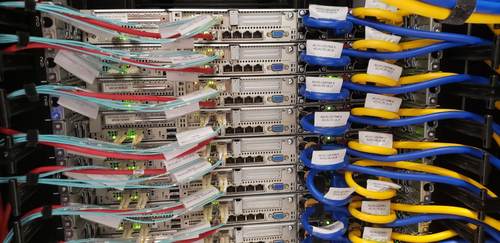
Two Industries, One Physics
I spent more than ten years in traditional data center operations before moving into bitcoin mining, so I come at this comparison from operations. The two facility types do the same basic job. They take in electricity, run it through silicon, and remove the heat that results. Beyond that, the business models differ, and those differences shape how each kind of site is designed, built, and staffed.
This post walks through the main differences. It describes common patterns, not rules. Some mining sites are built close to data center specifications, and some data centers run lean.
Where They Differ
- Power density. A typical enterprise rack draws somewhere around 5 to 15 kilowatts, though AI and high performance racks go much higher. A single air cooled ASIC draws around 3,500 watts, and a mining rack or container packs many of them together. Per square foot, mining sites commonly run several times denser than a traditional data hall. The electrical side is covered in Mining Electrical Basics.
- Uptime economics. A data center sells availability. Its customers run banking, retail, or communications systems, and an outage can stop their business. Data center contracts often state availability figures like 99.99 percent. A mining site produces hashrate, and its revenue depends on power price and bitcoin price. An hour offline costs that hour’s mining revenue, and at times an hour offline earns more than mining through curtailment. Mining hosting contracts commonly use lower uptime figures, often in the range of 90 to 98 percent.
- Redundancy choices. Data centers commonly invest in backup generators, UPS systems, and duplicate power and cooling paths, described with terms like N+1 or 2N. Many mining sites leave most of this out and put the money into lower cost power instead. Some keep partial backup for controls, networking, and monitoring.
- Cooling approach. Data centers usually condition air with chillers or CRAC units and hold temperature and humidity in a narrow band. Mining sites more often use outside air with fans and evaporative pads, or immersion and hydro cooling. These approaches cost less to run and expose machines to more variation in temperature, dust, and humidity. Questions about how site conditions affect ASICs often come up in hosting disputes. Airflow layouts are covered in Hot Aisle Cold Aisle Containment.
- Hardware lifecycle. Servers in a data center belong to many customers and run varied workloads. ASICs do one task and become less competitive as newer models arrive, often within two to four years. A single failed miner is a routine event on a large site, while a failed server may affect a customer application.
- Staffing and process. Large data centers often have staff on site around the clock, with formal programs for preventive maintenance, change management, alarm handling, and commissioning. Mining sites range widely, from small teams covering several sites remotely to large staffed campuses.
- Build speed. Data centers often take years from planning to operation. Mining sites can go from empty land to energized in months, using modular containers or prefabricated buildings.
What Mining Changes
The data center playbook does not transfer to mining unchanged. Some of its practices, such as preventive maintenance schedules, written change records, and commissioning tests before production load, appear at many mining sites in some form. Others, like full generator backup, rarely fit the economics of a load that can be switched off. Operators coming from the enterprise side adjust to commodity hardware, interruptible load, and faster hardware turnover. Operators who started in mining often borrow enterprise tools such as asset registers by serial number and single line diagrams.
Where each site lands on that spectrum depends on its power contract, its customers, its climate, and its budget, and people in the industry continue to debate which tradeoffs work best. Record keeping is one area where the two worlds overlap; I describe the common record types in What Records a Bitcoin Mining Site Keeps.
The short version
Data centers and mining sites share the same physics, but different business models lead them to different choices on density, redundancy, cooling, and staffing.
Explaining how mining facilities are built and run, and how they compare with other types of facilities, is part of my work as a bitcoin mining expert witness.
Common Questions
How is a bitcoin mine different from a data center?
Both move electricity through chips and remove the heat. Mining sites typically run at higher power density, use less backup equipment, rely more on outside air or immersion cooling, and turn over hardware faster. Their revenue depends on hashrate, power price, and bitcoin price rather than on selling availability.
Why do many mining sites skip backup generators?
A mining load can be switched off, and the main cost of an outage is the lost mining time, so many operators spend on lower cost power instead of generator and UPS backup. Some sites keep backup power for controls, networking, and monitoring.
Which data center practices appear at mining sites?
Many mining sites use some form of preventive maintenance schedule, change records, alarm monitoring, commissioning tests, single line diagrams, and asset registers. How formal these practices are varies widely from site to site.
What uptime figures do mining hosting contracts use?
Mining hosting contracts commonly state uptime figures in the range of about 90 to 98 percent, compared with figures like 99.99 percent in many data center agreements. Definitions and exclusions differ from contract to contract.
This article is general commentary on how bitcoin mining sites and hosting arrangements commonly work, based on industry practice and public information. It is not legal advice. Nothing here states an opinion on any standard of care or on any party’s conduct.
Evaluating a crypto dispute?
Aviran offers a no charge conflict check and initial case review. Available nationwide. See hourly rates.